Showing posts with label going natural. Show all posts

Sunday, July 26, 2015

Naughty by Nature

Textured hair hooray.....ho!
Working with textured (curly, kinky, wavy and straight) hair all day every day is way cool. Trust me, I can tell you a thing or two about theory versus practice as it relates to textured hair. Textured hair is so diverse and unabashed. It makes a mockery out of any one who calls themselves “specializing in it!”

There have been oodles of attempts by people, chemists and hair care companies worldwide to concoct a one size fit all product that will work on the varying textured heads of hair; NOT. There are also oodles of attempts by people, hairstylists and naturalists worldwide whom attempt to produce a one size fit all video that persons with their varying textures of hair can watch and duplicate; NOT. And there have been many of experts and novices who too have attempted to write books that attempt to teach and instruct people into a one size fit all 4 categories of textured hair; NOT.

I don't know if you recognize this or not; but there is a mass market appeal to tame the beast within textured hair worldwide. Folk are trying to find the one magic answer to taming textured hair like they are trying to find out how humans actually came into existence. It ain't gonna happen.

From the getty up, textured hair is difficult. Think back when you were a kid. What was your first view or words on textured hair? For most; words like difficult, hard, nappy and unmanageable quickly comes to mind. Why? Ignorance, fear and brainwashing. When folk don't know, they don't know. And ignorance mostly leads to fear. Fear makes you vulnerable to brainwashing. Yet, if you know textured hair and know what you are doing, there is absolutely positively nothing difficult, hard and unmanageable about textured hair. Even if it is nappy!
TBT (Throw Back Trig)

As a matter of fact, saying textured hair is difficult is like saying trigonometry is hard. Ask a mathematician and I guarantee; he or she would disagree. Saying textured hair is difficult is like saying children are loud. It’s the nature of the beast. And that is the beauty in working with math and textured hair...lol

Textured hair is naughty by nature. You have no option but to work with the texture you have. The confusing thing about textured hair is trying to wrap your mind around the very contrived, controlled notion and promotion of generalized textured hair versus individualized textured hair. Understand, generalizations are purposefully designed to help people along the way. The challenge is, most people interpret those generalizations, suggestions and advice as bond. They really take the word of what they hear. And they sincerely try to duplicate what they see.

In a world of nano technology, speed, quick, instant and fast; who in the hell has time for textured hair? Because anybody with or without textured hair who has the tiniest sense of knowledge in their head knows there is nothing quick about textured hair for most. So, in my Italian accent “Forgettaboutit!” And though it may not be as simple as quick as the touch or swipe of a finger; textured hair is NOT difficult.


Textured hair is unique and diverse.
Genetically speaking hair textures are as unique as the faces on the heads in which they lie. No two heads of hair alike (with the exception of identical twins). 

Understand that textured hair is like the leaves on a tree. Textured hair is supposed to feel grainy. Textured hair strands take on different shapes just like leaves. All strands are not the same. The climate affects textured hair just like the climate affects the leaves. Textured hair is influenced by its source. Just like leaves are affected by its source of a plant, tree or soil. Textured hair changes color just like the leaves on a tree. Textured hair is very unique to every unique individual who has it. Textured hair is unruly. Like leaves, it takes different twists, turns an coils as it grows from the scalp.
Imagine all leaves looking the same, ugh!

Textured hair is for the movers and shakers. It’s naughty by nature; not cuz it hates ya!

Textured hair is lovely. It requires KNOWING hands to work with it. In order to handle all its twists, turns and knots, it requires knowledge of it. It does not want to be straight. You can put all the chemicals, locs, weave, glue, thread, wigs, surgical transplants, hats, rollers, heat and products you want on it. At some point, the texture will return and it WILL win!  It wants to be wavy, curly, frizzy and big. It does not want to be shiny artificially; it wants to be shiny in its natural way. You know like a leaf. So don’t fret and fight too much to try to make it act like other textures you want and see.


Simply beautiful
Make it your business to learn your unique fabric. Remember advertisements, photos, videos, books and blogs are guides. Be selective in the products you use on your hair. Make the time to spend the time with your hair. It will never be as instant as shake and go for most. Last but not least if it works use it. Textured hair must be embraced by its uniqueness. When treated accordingly; it will yield results of beauty that would leave most speechless. 


"Smooth it out now!" 

Monday, May 11, 2015

When It Hurts So Bad

When it hurts so bad.
Being a female has many advantages. We get to adorn ourselves in many ways to look different. For example, we can wear certain clothes, shoes, jewelry and make up. We can polish our nails, gain or lose weight. And yes, we can even change our hair. Of the many things that we can do to adorn ourselves, two of those above mentioned have pain involved. Exercise and hair styling. Which one hurts the most? Well that is like choosing between the lesser of two evils. 

Hair styles are rad, cool, sexy, funky, conservative and they can be down right rebellious. A hair style can say a lot about a person before they even open their mouths. But the process of getting that hair style and the process of changing it as we see fit can be a tad bit daunting especially when you add texture to the hair styling process. 

What is it about textured hair that makes caring for it and styling it so dang on problematic and painful? Considering I take care of and style textured hair for a living, I have a clearer understanding of what the culprit is. In addition to working with textured hair,  I have a competitive advantage because I too have a head full of wavy Afro textured hair which adds to my knowing another level of understanding and credibility.  

The pain, headaches, oohs and ow's almost always comes from what I seriously think is the biggest culprit of them all. That one culprit is not knowing what kind of texture your hair is. I am always amazed by how  many people of color seriously believe that they all have kinky or and difficult hair. Why is that you ask again? Unfortunately, thanks to the people in marketing and those self appointed natural hair gurus for stereotyping an entire race of people. They have been very successful in doing this by duping masses of people into believing that race is somehow the determining factor to what kind of hair texture a person will have versus their genetics. There is something about the color of a person's skin that tricks even the most skilled into thinking that it is the skin color that determines what texture a person will have. That is not true. 


Natural hair and textured hair is not a Black thing.
It is a human thing.
For the life of me, I just do not understand how "natural" hair has become a "Black" thang. As if no other race of people have natural hair; not to mention textured hair. Why people? Why are so many people falling for this? In addition to stereotyping Black people, it is also the practices of hair care within certain races of  people that are passed down from generation to generation that I see as the problem to what makes caring for and styling hair difficult and painful. Often times these difficult and improper styling techniques are passed from culture to culture as well. When you put together generational practices and cultural practices; you end up with a brick wall of practices and techniques that are almost impossible to burst through. Again, why? It is simple; cultural practices trump. How? Because within those cultural practices are a level of respect and pride that people hold on to. Hence, self appointed hair gurus. People value the norms and practices of their family culture. Most of the people within that family structure have much respect for what has been, is being passed down or is introduced to them in hair care and hair styling. They want to pass it on. It becomes a "Black thing" simply because that person believes all Black people have the same issue. They will continue to pass on, share and practice improper hair care and hair styling techniques, even if it is wrong. 

They will do things like make YOUTUBE channels, create hair care products in their kitchen and sell it. They seriously believe most Black people have the same textured hair and are struggling with the same problems; even though they are not.  And most Black people will watch it because they want to believe it. The solutions are limited. The solutions are clumped together. Basically, they are sincerely looking for help.
As if women of color are the only people with "natural" hair. Really?


In my line of work, I use trichology (the study of scalp and hair) to help debunk that stereotype. I use trichology to tell people what they don't tell you at the hair salon. I also use trichology to help break the barrier to improper generational and cultural practices that lead to difficult and painful hair styling. As a matter of fact, hair styles are not even discussed until after we examine, determine and get a clear understanding of the individual's hair fabric (texture). I do not even consider race. It is the analyzing, the consulting and the customer's ability to recreate the care for and recreate the hairstyle that sets the tone for the salon experience. This process will eliminate what makes caring for and styling textured hair that hurts so bad. 

The cookie cutter approach to caring for and styling textured hair is causing millions of women to make poor choices about what to use on their hair and how to style it. The natural hair care movement is damaging textured hair in epidemic proportions. It is also the biggest rip off and the biggest contributor to this misnomer in hair. The branding and marketing of it all is preposterous. Again, the audacity to limit and depict "natural" to one race of people is racist. Folk need to leave their cultural practices at home, in the kitchen, in the chair and on the floor of their living room. They need to quit acting like they have been to Africa and is bringing back what all African people do to hair. Because all African people do not come from the same place in Africa doing the same thing to their hair. The mode of operandi via filtered images, social networking and outright overt cyber bullying to those who chemically alter their hair or use hair care products with synthetic ingredients reflects what an all time low certain people have stooped to make themselves feel and look important all because they don't like the hair that is on their head. And they do not know what to do with it. 


Stereotype, stereotype ad more stereotype. 
I have not made it a secret that I am not a fan of those images in magazines, books, social networks and any place else that depicts, advertise or promotes a school of thought that portrays that there are certain kinds of textured hair for guess who? Black people. Black women, to be exact. Then they had the nerve to come up with numbers and letters from A to D and 1 to 4 that they say the bulk of us are suppose to fit in. I ask who are "they?" And I say, "Really people?" What about Black men? As if they do not have challenges with their textured natural hair. What about the races of men who have textured hair? Do they not count too? This is not a black thang. Do you know how many Black people there are in America (not to mention the world) to deduce that many people of the same race to 4 numbers and 4 alphabets?  Damn can we at least get 26 images that represents hair textures? Although assigning each person a image along with a number to their own texture would be more like it. Don't suck your teeth, they give us all our own social security number, passwords and combination locks; surely they can do it for our hair! 

I mean, genetically and phenotypically (hmm, is that a word...lol) speaking, no two heads of hair are alike. It is impossible to categorize millions of black people with textured hair into 4 letters and 4 numbers. It is also ridiculous to exclude other races of people and sex who too have textured hair. I'm just saying... So stop with the shananigans already. Understand that regardless the letter or number there are too many people and another sex to conclude 4 common anything. I get that like clothing sizes, hair textures and types are nothing more than categories that are to simply designed to help us decide on what and what not to do or use on our hair. People, please understand that those categories are not absolutes. They are not even generalizations. Nothing in fashion is more interesting than to see a person who wears a size 14 successfully outfit herself into a size 10. It can be done, but I do not think that is best for the body type or the clothing itself. 

The clothing industry has done a magnificent job with categorizing a very large and extensive fashion industry to outfit everybody who wears clothes regardless of their cultural practice. They have done an excellent job at considering the varying races of people who wear clothes. They have also done a great job at developing a clothing size system to help people shop for what fits one's body size and type. The hair care industry has not. The hair care industry can not. Nor have they not put that much work into textured hair to do so.  I am just being honest. To sum this up, using something that is formulated for curly hair on kinky hair is not advisable. Just like wearing something that is a size 10 when you are a size 14. They are not nor will they ever be the same. Even if it reads, "For all hair types and same size fits all." 
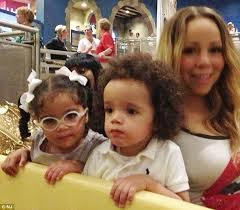
Mariah Carey and "Dem Babies." Funny, their  hair
types are not depicted in hair types A - D and 1 - 4...ijs


While getting your own seamstress to measure and design everything you wear is a tad bit much for the average bear, the concept of specialty stores makes a big as well as make clothes shopping a lot easier for the masses.

Because hair care and hair styling is a lot more affordable and more accessible than a seamstress; customizing is more achievable and doable for all who are interested. So, now back to this hair styling what can you do when it hurts so bad?

First things first. As you can see from reading what I just typed, I urge you to ditch the cookie cutter approach and ditch three things. Hair care products, hair styling tools and hair styling practices that oozes: natural hair, black hair care, women of color hair care, ethnic hair care on the bottle or and advertising. Instead look for the words that have the language of texture (curly, kinky, wavy, straight or and Afro) and the results you want to see on your hair in the hair care products. 


Black & Sassy: lively, bold and full of spirit.
cheeky. What does that have to do
with hair? This company should just use
the words at the bottom.
When it hurts so bad, the language on the bottle will help you better than the image you see in advertisement and in commercials. For example, ouchless, tangle free, combs easy, softens hair and so on. Next, it is imperative that you actually see the words "for curly, wavy, kinky, straight, straight, Afro, coarse, fine. limp, color treated, chemically treated or thinning and balding on it." If not, please put it back. For the record, like soap; when a chemist formulates a product, he or she is formulating for textures, types (weak, medium and strong in strength) and the results you want to see. The chemist is not formulating for race and cultural practices, norms and beliefs. Dove soap is used to clean skin regardless of race or ethnicity or gender. The makers of Crest would never brand, market, advertise and promote that their toothpaste is for White people only. They would never put it down and ethnic aisle. So do not make purchases according to what is being branded and marketed based off of race, lifestyle and attitude. For example, "Black and Sassy," "Baby Don't Be Bald," "Co-Washing." Buyer beware. 

Next, when it hurts so bad consider the cost. Be sure that what you are purchasing fits your budget. Then be sure to use the right comb for your hair texture and hair type. If you have dense, thick or very long tresses; you will need a comb with longer teeth that are closer together. Do not use a WIDE TOOTH comb; it will pull your hair out and compromise your curls, kinks, waves and Afro. Using the wrong comb is the second leading cause to why it hurts so bad. It is also the biggest culprit to compromised, damaged, torn and broken tresses over a relaxer and hair color on any given Sunday. I would bet my last dollar on that. So any one promoting wide tooth combs and de-tangling tangled, knotted and matted hair from the ends are wrong. 

The wide tooth comb is why it hurts so
bad.

Lastly, credibility. Refrain from buying what is new or trending. That means the hair product is still in the testing phase. That means that you and your hair are a part of the testing group. Buy from reputable companies and individuals who you knofw who have been around and have put in the research. They have a vested interest in your unique hair type and hair goal. These hair care companies also have grown with the changes in hair care and hair styling. Companies, who I call the quiet giants. Companies like P2 by Philiip Pelusi and Eufora, have been on the market for over 30 years. Decca Plus and Phyto have been in the market for over 40 years. Those four companies have been formulating products using the finest ingredients coupled with the latest technology for all textures of hair to make hair care and hair styling easy and pain free. They do not care about your race. Those are a few of my favorites. But their are many more.

In closing, I have to steal a thought processes my sister concluded the other day while we were on the phone about self esteem, When it hurts so bad, consider this .... "For all the time, money, energy, sweat and tears you put into building yourself up; do not allow someone to tear it all down." Especially when all they are looking for is money, popularity and a "Like" on social network. Now that would truly hurt so bad.

Sunday, December 21, 2014

The Transition Mission


 Believe it or not, I am not one of those cosmetologists who promotes salon visits. Yeah, I know! As a matter of fact, the main reason I opened a salon was to teach every person who walks in about the hair on their head, how to care for and how to style it. Really, you say? Really!
Afro

Some time ago "relaxer," "creamy-crack," "chemically altered hair" and all that jive started to become the fearing buzz words in the salon world of hair care like the Ebola virus scare came to CDC in the world of viruses. As a cosmetologist with a degree in social science, this craze really caught my attention. Soon, I found myself becoming to hair care what Michael Moore became to the government, the food industry, globalization, assault weapons and the American health care systems; a whistle blower.

Regrowth

While I do not possess the talent to write and produce documentaries; I do have the talent to write. Just as the attack on the Twin Towers in New York, the killings of innocent teens while at school in Columbine and the ignorance to the over consumption of fast foods irritated Mr. Moore to the point of investing his time, energy and money into exposing those wrong doers for what they were worth; the same for me in hair care. 
Flat ironed tresses to the left....

Nothing irritates me more in hair care than licensed hair stylists and hair care companies claiming they can make hair healthy. When they know it is the blood supply fueled by genetics, diet, exercise and bowel movements that does. Another irritant for me is now how all of a sudden relaxers are bad for your health and your hair. I still remain perplexed how the chemists, marketing execs and the companies themselves have allowed the same licensed professionals who educated for them, sold for them, used for them, promoted for them, applied their chemical relaxers to millions of women world wide and encouraged them to charge those millions of consumers worldwide for having their hair chemically altered. I am surprised how they have not backed up their claim that has always been stamped on every tub, printed on every direction in almost every language and taught by almost every instructor; DISCONTINUE USE if allergic reactions occur. To the credit of most companies; they have never claimed that their chemical relaxers were for everyone. The ownest has been and will always be on the person applying the chemical to be trained and follow the manufacturers instructions. 

So here I am today writing a blog about another thing that irks me, the transition scare! Good lawd, some of these hair stylists and hair care companies have lost their minds encouraging those who do not like or have had a reaction to the chemical to cut it all off. I am all for the option to cut it off for whatever reason, if that is your choice. But, when one enters the salon with over processed tresses; to be honest, cutting it off is the best option for the severely damaged hair. Anything less is hype.


Victoria's secret ain't so secret no more.
"TBH," as my colleague Malika Jones always says, when you break down the most common ingredient found in chemical relaxers: sodium hydroxide. The sodium hydroxide is nothing but salt, water and oxygen fluffed up with petroleum, conditioners, synthetic proteins and all that jive which all DRIES out hair to RELAX the texture (curly, kinky, wavy and Afro). It is the HEAT from the hot water, blow dryer, hooded dryer, curling iron or flat iron that STRAIGHTENS the hair. The relaxer never claimed to straighten the texture. The relaxer claimed to RELAX the texture. The side affects those drying chemicals are often excessive drying or irritation to the scalp, neck or/and forehead. Allergic reactions such as swelling, redness, bumps or burning (to those with sensitive skin) has always been explained either on the bottle, in the instructions or in training to licensed hair stylists. Just medicine or any other thing that is ingested or apply topically to your skin can irritate it; so can the relaxer. And for the record anything that is applied topically to your skin, NOT JUST THE RELAXER enters into your blood stream, going directly to your liver and kidneys which will filter out most toxins from the stuff we put on our skin. So if you think creamy crack is just gawd awful, then toss out all that Victoria's Secret,  Bath and Body Works, Flower Bomb perfume, MAC make up and more. I mean most people put that stuff on twice a day every day and more. Some even wash up in it. Do you do that with a relaxer?
The world's best protein
Voila!
So versus being scared to grow out your relaxer, be open to the options of what it takes to do so. If it is your personal desire to cut it off; then do so because that is what you want to do; not because someone told you to do so because relaxers are toxic. 

The easiest and most affordable way to grow out your relaxer is to incorporate a protein treatment into your hair care regiment that protects the outer layer (cuticle) and second layer (cortex) of your hair. If the protein you are using reads that it is only for the outer (cuticle) layer; you may not be impressed with the results and unwanted breakage may continue to happen. If you use a protein that reads that it can penetrate to the second layer (cortex), BINGO you are in luck! The cortex is where the actual strength of the hair is. So using a protein of that nature will increase the likelihood of strengthening the entire strand of hair (regrowth, mid-shaft and ends) which will decrease the likelihood of your hair breaking off at the demarcation line (where the regrowth and relaxed hair meets).

In conclusion, if you add that simple product to your hair care regimen...the transition will be successful. As for what is toxic and can kill you? That is another blog!